
“I’m still blown away by how desolate Iceland can be, how deserted it is. It’s very often like living on the moon.” – Olafur Darri Olafsson, Icelandic-American actor and screenwriter

Iceland – One Great, Big, Beautiful Lava Field
One cannot truly fathom what Iceland, the Land of Fire and Ice, will be like until stepping foot onto the damp tarmac at Keflavík International Airport and experiencing the expansive, dried lava fields on the way into Reykjavík; volcanoes looming off in the distance.
So begins our summertime double adventure that begins with a Viking Cruise circumnavigating Iceland, then a quick flight over to Ireland, the Emerald Isle. Both will reveal their startling, unique beauty and enchantments along the way.

But first, since the best air route for us was through New York, we made a short stop in The Big Apple for some long overdue cultural stimulation, alongwith family and friends reunions.
Of course, Broadway beckoned: “Boop! The Musical,” is a throwback old-timey musical featuring high-kicking tap dancing, vibrant songs and colorful stage settings. Best was witnessing the breakout “Star is Born” performance of the title character, Jasmine Amy Rogers, Tony Award nominee.


“Oh, Mary!” is a comedic stage play that asks, “What if Mary Todd Lincoln secretly desired to be a cabaret star?” What followed in this finalist for the Pulitzer Prize for Drama was side-splittingly funny and was totally “out there,” in its irreverence. Cole Escola won the Tony Award for Best Actor/Play.


“Call me Izzy,” is a powerful, one-woman dramatic play at Studio 54, starring Jean Smart, in a tour-de-force role that deals with the tough subject of spousal abuse. One critic’s review called her performance “… dazzling, stirring and soulful.” We second that; as we sat mesmerized and riveted from start to finish.


Newly stimulated, our European adventure began with an under six hours, overnight Icelandair flight to the Land of the Midnight Sun, which in July, amounts to 20 hours of daylight …

A quick history of Iceland, a fascinating island nation, with its unique blend of Viking heritage, isolation, and modern innovations …
The Norse Vikings, mostly from Norway, began arriving around 870 AD, along with some Celtic slaves and settlers from the British Isles.
By 930 AD, settlers had established the Althing, the world’s oldest surviving parliament, at Þingvellir (Thingvellir), Iceland; becoming an independent commonwealth ruled by chieftains and laws, not kings.
In 1262, Iceland came under the Norwegian crown by treaty; followed by Danish rule that lasted over 500 years, during which Iceland endured natural disasters, volcanic eruptions, harsh winters, and poverty.
In 1918, it became a sovereign state under the Danish crown; 1944 saw its full independence. By the way, Iceland elected in 1980 the first female head of state in the world.
Since the 1990s, Iceland has become known for its renewable energy, technology, high standard of living, and resilience.
Reykjavík
The city is the world’s northernmost national capital and is home to about 140,000 residents; accounting for 64% of Iceland’s population within its metro area. (Now I’ve laid claim to having been to the northern-most capital and highest capital city, La Paz, Bolivia.)

The name Reykjavík translates to “Bay of Smoke;” having derived from the Old Norse words “reykr” (smoke) and “vík” (bay), and named for the steam rising from natural hot springs around the bay.
Its history begins in 874 AD, when the Norse settler, Ingólfur Arnarson, established the first permanent settlement. 900 years later, in 1786, it became known as a trading town, thus setting the stage for its growth as Iceland’s political and cultural center.

Being so far north, the length of days in Reykjavík changes dramatically throughout the year, due to its high northern latitude (64° N). During July, we experienced an incredible 20 hours of daylight, which proved disconcerting, as the sun barely sets, hovering just below the horizon, creating a twilight glow all night. It played havoc with our circadian rhythms, as our internal clocks were going wild! Even with black-out shades, the body/mind sensed the deception.
Reykjavík is known as one of the greenest, safest cities globally and scores high in “best cities” rankings as also one of the most expensive, being an isolated island in the North Atlantic. Like the Icelanders say – the only cheap thing is heating (geothermal), electricity and the purest glacial water.
Hot Diggety Dog!
Our first mission was to search out the famous Icelandic hot dogs or “pylsur.” They’re a national obsession and a must-try; being affordable, delicious, and uniquely Icelandic in both flavor and tradition.
The tasty and unique meat blend is mostly lamb, with some added pork and beef. The lamb is free-range and grass-fed, giving the hot dog a distinctive, slightly smoky flavor. Icelandic pylsur are natural-cased, which gives them a satisfying snap when you bite into them.
They’re served on a steamed bun, and you order your hot dogs “eina með öllu” or “one with everything” – crispy fried onions, ketchup, sweet brown mustard, and a remoulade, which consists of a mayo-based sauce with mustard and sweet relish.

We headed straight for the best known purveyor – a small, bright red stand open since 1937, Bæjarins Beztu Pylsur, which simply means “The Town’s Best Hot Dogs.” And folks, this isn’t false advertising.
We joined an eagerly waiting queue under a light rain, and quickly purchased three hot dogs. David asked why not just two, but I said that if they’re that good, and we needed an extra bite or two, it would behoove us not to have to queue up again. We devoured them both and shared the third, relishing every snappy bite.

The casing was crisp, the meat blend savory, and the sauces all danced harmoniously with each other; creating a happy sensation on the taste buds.
We also found out that Icelanders don’t only cherish their hot dogs, but they’re also nuts over cinnamon rolls; a favorite sweet treat of mine, so we had one more stop to make (well maybe two).
Cinnamon Rolls!
Cinnamon plays a surprisingly prominent role in Icelandic cuisine and culture, especially in baked goods and sweets. Their version is sometimes topped with a sugar glaze, icing or even chocolate. They’re infused with cinnamon, but certainly not overwhelmingly.

You can find them all over, and best enjoyed with a hot cup of coffee. I’m particularly devoted to a very hearty, well-dusted cinnamon roll, but didn’t decline any of the more subtle, Icelandic versions tasted.
We tried the best known at Brauð & Co, famous for its colorful toppings and then at Baka Baka Bakery; coincidentally founded by the same baker of the former.


Hot dogs + cinnamon rolls = what could be better to this happy and satisfied camper!
Hallgrimskirkja Church
Reykjavík’s iconic, striking landmark is visible from throughout the city, as it stands prominently on its hilltop. It’s named after the 17th-century poet and clergyman, Hallgrímur Pétursson, renowned for his “Hymns of the Passion.”
The Lutheran Church took 41 years to build after its initial design by state architect, Guðjón Samúelsson; being completed in 1986. It emulates Iceland’s basalt lava formations and glaciers; blending Expressionist and Neo‑Gothic influences.


The tall tower, nave, and sanctuary combine rugged, column-like concrete “wings” with a cylindrical end reminiscent of a Viking’s helmet. Additionally, Reykjavik’s rainbow street, painted in the colors of the rainbow, represents the city’s commitment to LGBTQ+ rights and its welcoming attitude towards diversity and inclusion.
A formidable sculpture of Leif Erikson stands forth in front. He was a Norse explorer thought to be the first European to set foot on American soil, way before Columbus. The statue was gifted by the U.S. in 1930 to mark Iceland’s parliamentary millennium.

The church’s interior is intentionally austere: white-walled, minimalist, and dominated by a magnificent organ with 5,275 pipes. The church is infused with natural light.


A quick elevator ride to the top brings you to an observation deck providing unobstructed 360° panoramic views of Reykjavík, and its surrounding mountains, Faxaflói Bay, and the ocean stretching west to views of Greenland and the Americas on clear days; today, not so.

Our first day provided a great introduction to Iceland. Tomorrow we head inland to the Golden Circle before boarding the Viking Mars and begin circumnavigating Iceland.
Golden Circle
If you’ve got just one day to spend in Iceland, then you must do The Golden Circle Tour. It’s the most popular and iconic day trip in Iceland. It’s a 190 miles circular route that showcases Iceland’s incredible geology, history, and landscape, all easily reached from Reykjavík.
It includes three of the main natural attractions and an ever-changing landscape. Our eleven-hour day trip will be full of other surprises.
BLUE LAGOON
Ahhh … our Golden Circle Tour begins at the world famous Blue Lagoon Spa. The large, geothermal spa is a milky‑blue oasis nestled in the moss-covered lava fields of the Reykjanes Peninsula; just 32 miles from our hotel.
The large lagoon is man-made; filled with runoff from the Svartsengi geothermal power plant. Rich in silica, salts, and algae, the water renews every two days and contains no harmful bacteria thanks to its mineral composition.
We soaked in its warm, healing waters that are beneficial to the skin due to its rich mineral content; nicely heated to a comfortable 100-102 °F. The outside temperature was around a chilly 60 degrees or so, making it best to stay down low.


After leisurely soaking in the soothing waters, you head over to a kiosk where you’re offered a silica mud mask; one of their signature skincare treatments. The mask’s natural compound is found in the geothermal seawater of the Blue Lagoon. You spread the creamy, white mud over your face. Then wait.
After 5-10 minutes, it’s removed; removing impurities from the pores, reducing excess oil, and helps improve skin texture and tone. It felt like a quick and natural, firming facelift, leaving one’s face feeling oh so soft as a baby’s bottom. The Blue Lagoon certainly lived up to and beyond its reputation.
*** an interesting side note … a week later, the Lagoon was closed-down with a nearby lava flow, as seen on live television at our hotel.

Gullfoss
Second on the Golden Circle is Gullfoss, translating to “Golden Falls,” one of Iceland’s awe-inspiring waterfalls. Gullfoss plunges thunderously in two stages: first, a 33-foot drop; then 63-feet; falling into a narrow canyon that makes the waterfall seem to disappear into a “Middle-earth Hobbit World.”
On sunny days, spray from the falls creates vivid rainbows, adding to its beauty; however, today was not that day.


There is such a raw, powerful beauty to waterfalls; watching them sets me in a trance, with the world around disappearing, and all you feel is the force of the water. I experienced the same feelings standing in front of Niagara Falls and Iguazu Falls … maybe it’s time to start planning a visit to Victoria Falls.
This is one of two majestic waterfalls that we’ll experience in Iceland, as the whole country is peppered with them.
KERID
Kerið (or Kerid) is another great wonder – a volcanic crater lake in South Iceland’s Grímsnes region. It’s around 6,500 years old – much younger than most Icelandic craters; most likely formed by the collapse of a cone volcano after magma emptied; leaving a bowl-like caldera which filled with groundwater, forming the lake.
There’s a striking contrast of red volcanic rock walls, vivid aquamarine lake, and green moss. The lake’s blue‑green color is mineral-driven, not sky-reflected. An overall stunning, natural spectacle.

This caldera reminded me of the one we visited in Ecuador, the Quilotoa Caldera, which is also filled with mineral-rich turquoise water, but much younger since it was created 800 years ago by a massive eruption.
GEYSIR
Wonder where the word geyser comes from? Geysir is an Icelandic word first spoken in the 1600s. The Great Geysir (or just Geysir) is an iconic, geothermal feature that gave its name to all geysers worldwide. It was formed over a 1,000 years ago, erupting into spectacular jets of boiling water over 200 feet high. Today, it rarely erupts – most recently in 2016, but remains mostly dormant.
But just 150 feet southeast of Geysir, Strokkur, or small geyser, does erupts with impressive reliability every 4-10 minutes. Typical eruption heights are sixty feet; sometimes reaching up to 120 feet on rare occasions.
We waited patiently on its perimeter for this natural wonder to blow, watching closely, since before the eruption, water bubbles begin to swell, and the surface vibrates, and with perfect photo timing, gave us front-row thrills and excitement.
ICELANDIC HORSE
A horsey treat followed, as we stopped by an Icelandic horse farm. For a small fee, I purchased some horse candy, and got to feed, pet and stroke these beautiful, strong animals.
The horses were first brought to Iceland by Norse settlers between 874-930 AD; crossing from Norway and the British Isles. The country banned horse imports around 982 AD, making the breed genetically pure for over a millennium. Horses exported from Iceland are never allowed back, ensuring disease control and genetic isolation.


Pony-sized by global standards, they’re firmly considered true horses in Iceland. They’re built for endurance with short, muscular bodies, strong legs, thick winter coat, plus a full mane and tail. There’s up to forty base colors and over one hundred patterns, from chestnut and black to rare roans (coat color pattern).
Most Icelandic horses naturally perform five gaits: walk, trot, canter/gallop, tölt, and flying pace. They’re very friendly, intelligent, curious, strong and spirited.
Riding an Icelandic horse while holding a beer is a real (and fun) part of Icelandic horse lore, and it’s tied to one of the breed’s unique gaits. The tölt is a four-beat gait unique to Icelandic horses; being incredibly smooth, with little up-and-down movement in the rider’s seat.


You can theoretically ride without spilling a drink and yes, people test this with beers, cups of coffee, and even full trays. It’s said that if you spill, you are human, if you don’t, you’re an Icelander.
I wish we could have had more time, and would have loved to have ridden them. These horses aren’t just sturdy and beautiful, they’re legends with Viking heritage.
Thingvellir National Park
Þingvellir, or Thingvellir National Park, is a historically significant, natural site. It sits in a rift valley formed by the separation of the North American and Eurasian tectonic plates where you can literally walk between continents.
An UNESCO World Heritage Site since 2004, it’s home of the Althing (Alþingi), one of the world’s oldest parliaments, founded in 930 AD. For over 800 years, Icelanders gathered here to make laws, settle disputes, and celebrate cultural traditions.


We walked along a path with ridges reaching high into the sky in what looked like a fortress, but was actually a natural rock formation. I racked my brain trying to remember where I’ve seen this formation before, and after a Google search, found it was featured in “Game of Thrones” – in scenes beyond the wall. A good portion of GOT was filmed around Iceland.
Grindavík – The Lava Flow
It was an eerie drive through the abandoned town of Grindavík, located 80 miles southwest of Reykjavík; having been evacuated multiple times during volcanic eruptions in the early 2020’s.
These events stem from the Sundhnúkur-Svartsengi volcanic system, which reactivated after an 800-year dormancy. 3,800-4,000 residents were displaced, and relocated across Iceland to shelters and towns.
Several houses and critical infrastructure, such as hot‑water pipelines and roads were damaged or destroyed.


The Icelandic government has since offered to buy properties, assume mortgages, build defensive barriers, and continues to permit brief access for personal effects.
The region remains in “Alert Phase,” with ongoing seismic and volcanic monitoring. Scientists warn similar eruptions could continue for months or years.
In fact, upon disembarking from our 7-day cruise, there was a small eruption. It was featured on all the news channels and the smoldering smoke could be seen driving to the airport.

Tundra
An interesting roadside stop brought us face-to-face with tundra-like vegetation including mosses, lichens, and small hardy plants that have begun to colonize the bare, volcanic rock.
Walking about, you felt you were squishing the vegetation, but surprisingly it bounced back very quickly. It was necessary to take precaution as there’s unseen, deeper fissures in the rock; all covered by tundra. Our guide said that we were ok in this particular area.


As lava ages, these pioneer organisms – the lichens and mosses, serve as precursors to more complex vegetation like shrubby heathland and birch forests. Typically, this succession proceeds over centuries.
Icelandic Phallological Museum
Ok, I have visited a few quirky museums in my lifetime, but this takes the all-time crown. I couldn’t resist the Icelandic Phallological Museum, home to the world’s largest collection of phalluses and penile parts from an array of mammal species.
Dear reader, if you can name it, it was on display in formaldehyde jars; some several feet high. I felt like I had stepped into a science lab with beautifully displayed and lighted samples, all properly identified and curated.
Often dubbed the “Penis Museum” in Reykjavík, it’s truly one-of-a-kind. Founded in 1997 by Sigurður Hjartarson, it grew from a personal collection that started back in the 1970s.


The collection contains over 300 specimens from more than one hundred mammal species … from a blue whale penis at 67 inches long and weighing 154 pounds (at full length and weight it might be 16.5 feet and 770 to 990 pounds!!), to a tiny hamster baculum (bone), at just .0787 inches and viewable only with a magnifying glass. There’s also a human species generously donated by a 95-year-old Icelander.
By no means is it taken all that seriously, since they also have a folkloric section with mythical “specimens” such as elves, trolls, kelpies, ghosts, and tongue-in-cheek art sculptures.
Overall, it’s a thoughtfully curated museum and shouldn’t be considered a tawdry sideshow, but an oddly academic and tasteful presentation.
Icelandic Observations
Everyone always says you must visit Iceland. Whenever I travel, it’s with a blank page and no preconceived ideas. Iceland quickly colored in that page with wonderful experiences, and we haven’t even begun to explore all it has to offer.
As it was said, Iceland basically has two seasons: “Winter and Disappointment.” So far this year, it hasn’t been much of a summer since May was hot, and June cold and rainy. July was cold, wet, windswept, and kissed with rays of sunshine, all in one day.
They don’t have snow days, but sunshine days, enabling people to take time off and enjoy nature.
Icelandic people are very stylish – you can quickly identify them from the throngs of tourists. They’ve literally developed a layered style of fashion, and like an onion, they slowly peel it off as the day’s weather changes.
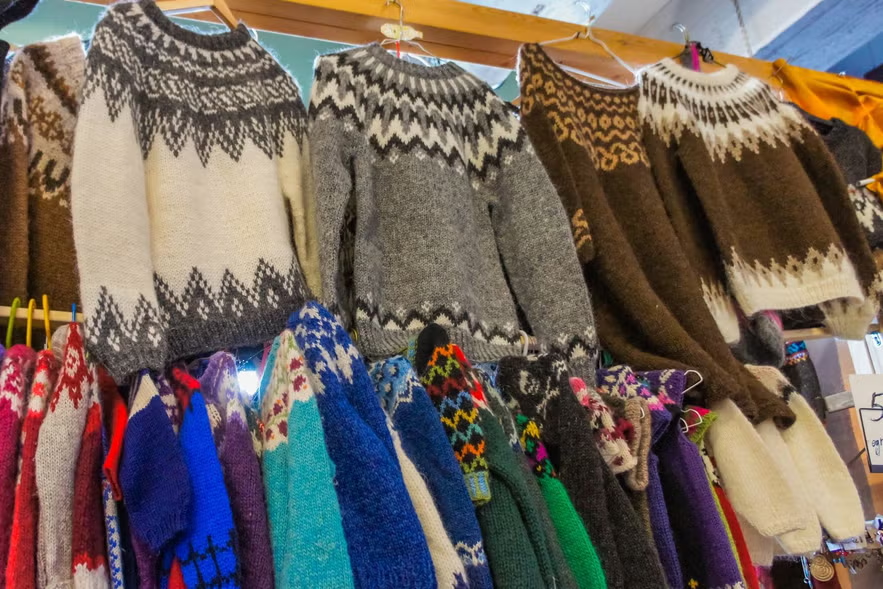
Here I must mention the gorgeous Icelandic sweaters with their beautiful design patterns, but with such a rich, dense, warm wool, I’d need to install a walk-in freezer at home to wear them.
We’d have several outstanding meals during this trip, but our last meal in Reykjavík had to be the best Lamb Ribeye ever to pass my taste buds, dancing with joy from the first bite to the last. The rich, smoked lamb carpaccio appetizer added to the sublime succulence.


Tomorrow we ship out to explore the rest of the island onboard the Viking Mars.
As seen on the streets……


Related Posts


Broadway! What a treat. A marvelous stopover on your way to Iceland.
With history stretching back to the Viking’s, I thoroughly enjoyed learning more about Iceland. As always Sergio, your narration was fascinating. From Reykjavík’s gorgeous Lutheran Church to the Golden Circle’s stunning natural wonders, you took us on a special journey. The Kerid caldera and Gullfoss waterfalls especially stood out.
Hot dogs and cinnamon rolls would have been a trip highlight for me, as well as the scrumptious looking lamb dishes.
As seen… a masterful compilation of Icelandic human interest photos. Thank you for another fabulous Musings, Sergio.
You are always so kind with your reviews – glad you enjoyed our 1st instanllment of a fantastic trip.
Fabulous…………..hopefully my next trip is to Iceland! Thank you for sharing.
You should go right ahead and book it, you will have a wonderful experience.
So glad you guys visited Iceland. Excellent pictures and commentary as usual. It is one of of our favorite travel destinations! We were lucky to have been there in September of 2018 when a heavy snowfall transformed the landscape into a white wonderland!, covering over the pervasive black lava. We also enjoyed the people, Icelandic culture, great food, the native horses, and Iceland’s rich history. We were able to get up and personal with a glacier even tasting one of its icicles! Can’t wait for your next adventure!
It has to be up on the top 5 on my list. It was an amazing experience.
Thank you for sharing all the beautiful places that you both have traveled and toured. I enjoyed them all.
Thanks you for reading about our adventures.